 Entwurfsforschung
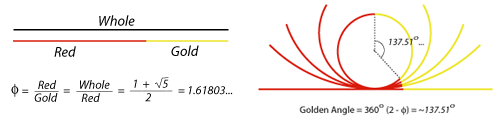
Viele Proportionen innerhalb natürlicher Strukturen lassen sich mit dem Goldenen Schnitt bzw. den Fibonacci Folgen beschreiben. Bei der bekanntesten Fibonaccifolge ergibt sich der jeweilige Wert aus der Summe der beiden vorherigen Zahlen:
1, 2, 3, 5, 8, 13, 21, 34, 55, 89, 144, 233, 377, 610, 987, 1597, 2584, 4181, ...
Teilt man eine Zahl aus der Reihe durch die darauffolgende, so ergibt sich ein Näherungswert des Proportionsverhältnisses des Goldenen Schnitts. Um so größer die gewählten Zahlen sind, desto genauer ergibt sich der Wert.
610 : 987 = 0,61803 entspricht dem Verhältnis 1 : 1,61803
Beispielsweise verwendete Iannis Xenakis die Fibonaccireihe zur Fassadengestaltung des im Büro von Le Corusier geplanten Kloster La Tourette bei den sogenannten 'Ondulatoires'.
 ___________
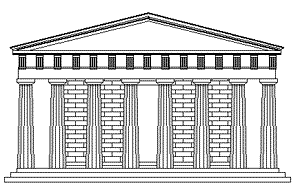
Der Goldene Schnitt diente bereits im Altertum der Gestaltung harmonischer
Proportionen, hier am Beispiel des Parthenon.
weiterführende Links zur Zahlentheorie und anderem:
http://www.mscs.dal.ca/Fibonacci/
Many proportions within natural structures can be described with the golden ratio or the Fibonacci sequences. In the best-known Fibonacci sequence, each value is the sum of the two preceding numbers:
1, 2, 3, 5, 8, 13, 21, 34, 55, 89, 144, 233, 377, 610, 987, 1597, 2584, 4181, ...
If one divides a number in the sequence by the following one, the result is an approximation of the proportion of the golden ratio. The larger the numbers chosen, the more precise the value.
610 : 987 = 0.61803 corresponds to the ratio 1 : 1.61803
For example, Iannis Xenakis used the Fibonacci sequence for the so-called 'Ondulatoires' in the facade design of the La Tourette monastery, planned in the office of Le Corbusier.
___________
The golden ratio was already used in antiquity to create harmonious proportions, shown here using the example of the Parthenon.
further links on number theory and other topics:
http://www.mscs.dal.ca/Fibonacci/